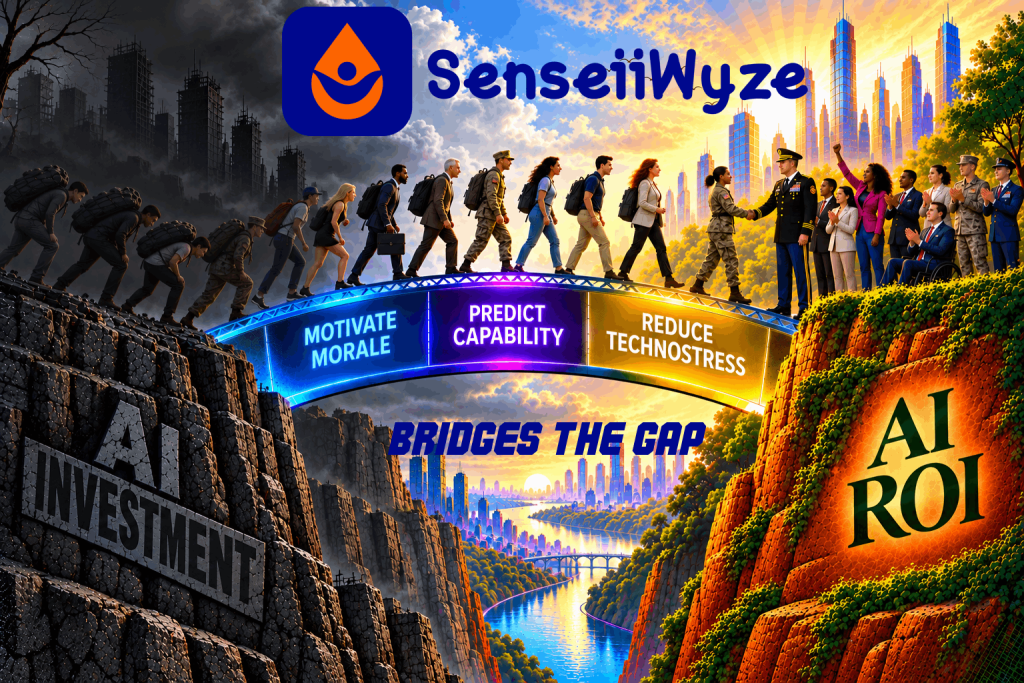
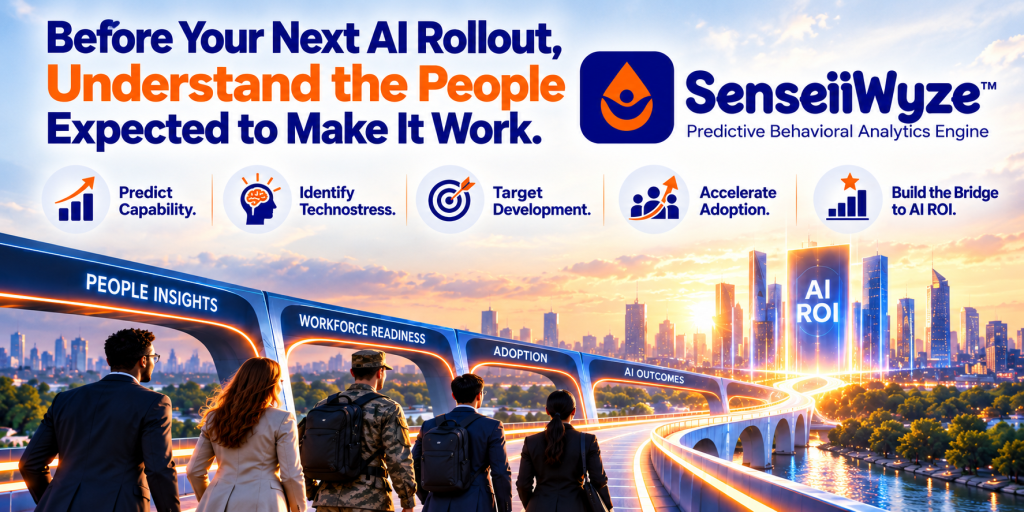
The hardest part of AI ROI isn’t the AI. It’s the people. Organizations typically buy technology and training first, then discover where workforce capability and resistance exist later.
SenseiiWyze™ reverses that sequence.
It predicts whether employees have the behavioral readiness to learn, adapt, and succeed with rapidly changing technology—while identifying the technostress that can create resistance and slow adoption.
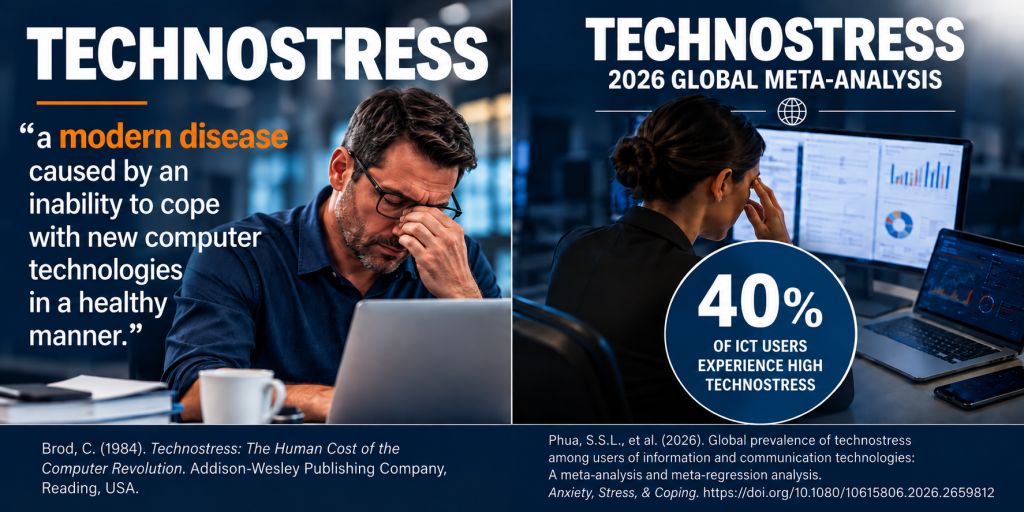
Technostress was discovered by research Craig Brod in 1984 as a modern disease caused by an inability to cope with new computer technologies in a healthy manner before major personal computers and the public internet.
Technostress can affect confidence, learning, productivity, and willingness to adopt new systems. Researchers in 2026 surveyed 18,535 people across 23 countries to discover 40% of internet communication and technology users experienced high technostress.
Technostress rarely begins with an employee saying:
“I refuse to use this technology.”
It often begins quietly.
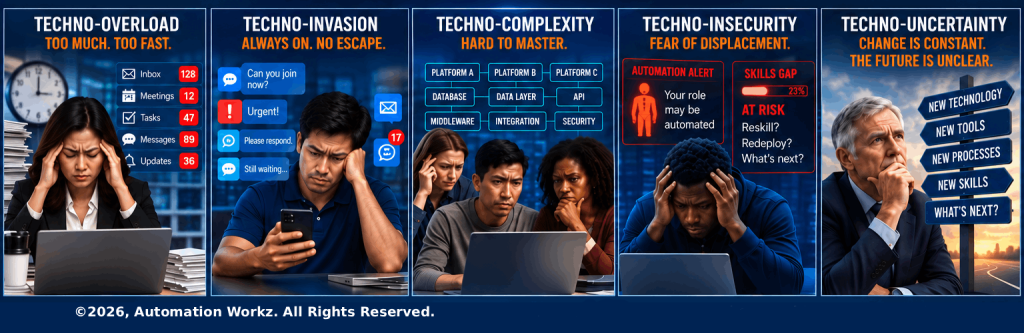
THE FIVE FACES OF TECHNOSTRESS
TECHNO-OVERLOAD
Too much. Too fast.Too many systems, messages, tools, and simultaneous demands.
TECHNO-INVASION
Always on. No escape. Technology extends beyond normal work boundaries and makes it difficult to disconnect.
TECHNO-COMPLEXITY
Hard to master. New technology feels difficult compared with an employee’s existing knowledge and experience.
TECHNO-INSECURITY
Fear of displacement. Employees worry that AI, automation, or coworkers with stronger technology skills could reduce their value.
TECHNO-UNCERTAINTY
Change is constant.New tools, workflows, expectations, and skills continue changing before employees feel comfortable.
These stressors can affect performance, productivity, role functioning, and technology adoption.
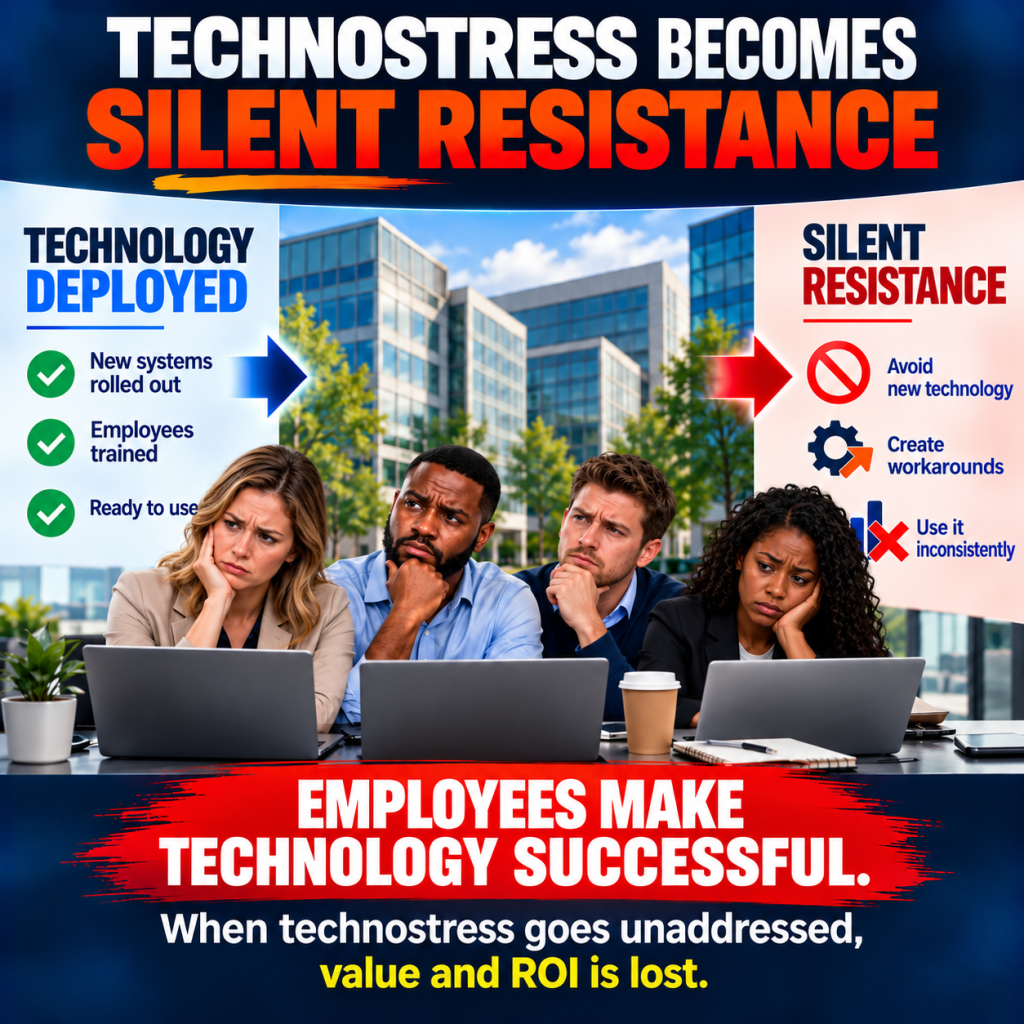
TECHNOSTRESS CAN BECOME SILENT RESISTANCE
Employees may do exactly what leadership asks.They attend the training. They log into the new software. They experiment with the technology. They appear to be using it.
Then real work begins.
A deadline hits. A customer needs an answer. Pressure increases. And employees return to what feels familiar. The spreadsheet comes back. The manual process survives. The legacy system stays open. A workaround gets created. The new technology is used only when required.
A login is not adoption.
The technology may be deployed while the old way of working continues underneath it.
That is silent resistance.
EMPLOYEES NEED TO BE FULLY ENGAGED TO MAKE AI AND TECHNOLOGY ADOPTION SUCCESSFUL.
When technostress goes unaddressed, value and ROI is lost.
SENSEIIWYZE™ CHANGES WHAT HAPPENS BEFORE TRAINING
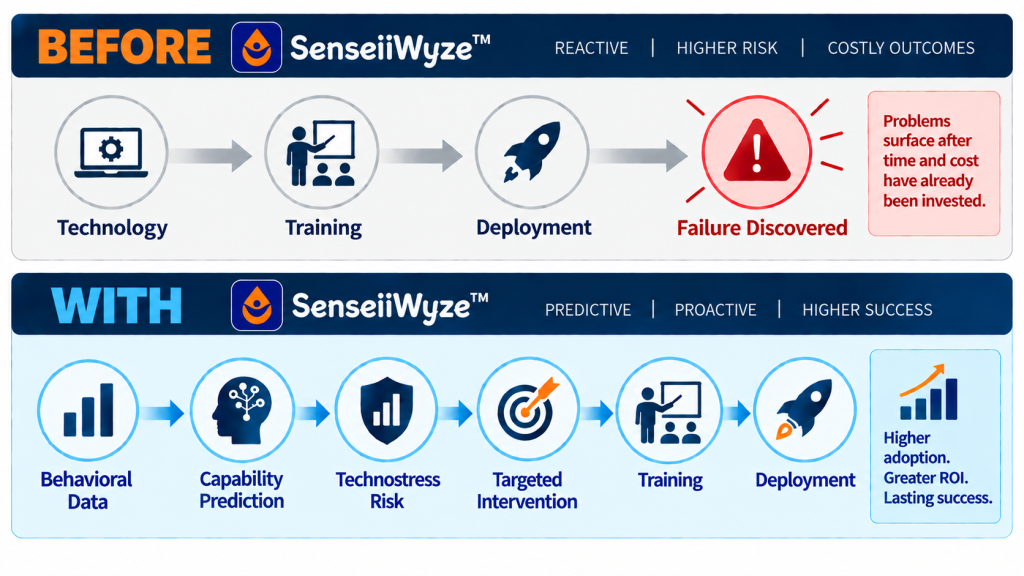
Most organizations follow a reactive timeline. They buy the technology first, train employees on how to use it, deploy it across the workforce, and only afterwards do they discover where resistance, capability gaps, and adoption problems exist. By then, much of the investment has already been made.
SenseiiWyze™ moves behavioral intelligence earlier in the timeline. Before major training and deployment, it generates behavioral data to help leaders predict technology capability and identify technostress risk. Those insights can then guide targeted coaching, development, and training before employees are expected to fully adopt the technology.
THE DIFFERENCE IS TIMING: instead of discovering the human problem after deployment, SenseiiWyze™ helps leaders see it before it becomes an adoption and ROI problem.
Some employees need more technical knowledge. Some need practice. Some need confidence. Some need coaching. Some need support through change. And some possess technology capability that traditional workforce data may overlook.
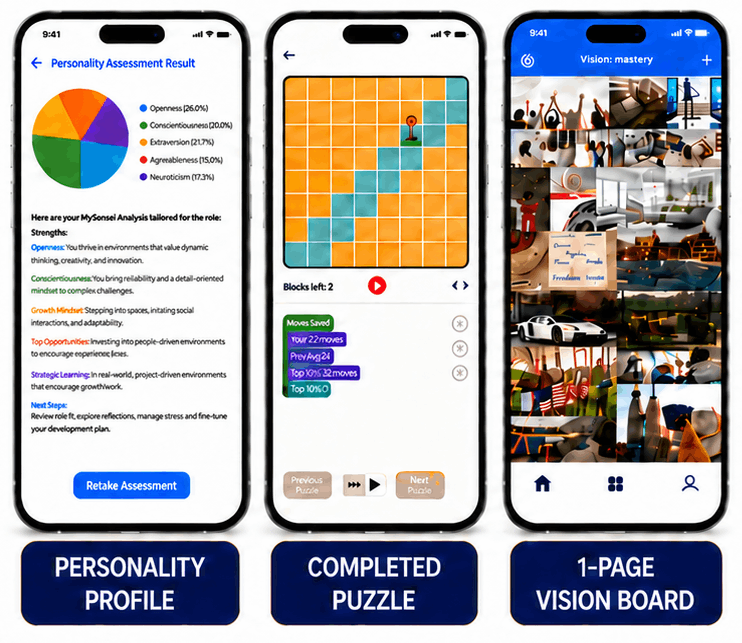
SenseiiWyze™helps leaders distinguish the difference. Employees complete three behavioral data profiles:
Personality Profile Behavioral tendencies related to learning, persistence, collaboration, and change.
Puzzle + Maze Games Behavioral signals related to problem-solving, pattern recognition, persistence, spatial reasoning, and response to difficulty.
Digital Vision Board Behavioral signals related to motivation, goal clarity, visual preferences, and future orientation.
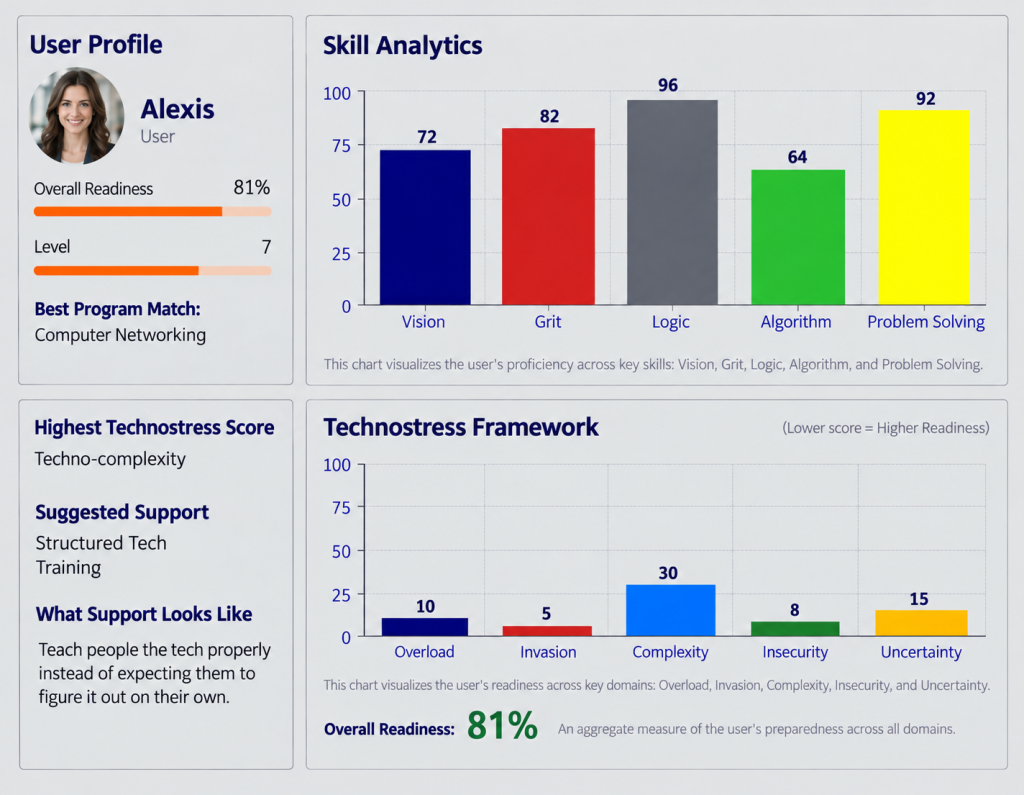
SenseiiWyze™ analyzes these profiles according to 10 behavioral signals to give leaders a clearer view of technology capability and potential technostress.
SenseiiWyze™ provides
1 – tech program match in AI, Cybersecurity, Data Analytics, IoT Tech Support, or Computer Networking.
Graph of 5 Skills Analytics
Graph of 5 Technostress Categories
Overall Readiness Score
1- Suggested Support/ Intervention
No more guesswork!
Determine which employee has the tech capability and low technostress risk, signifying they are adaptable and will probably not exhibit resistance behavior during the adoptionprocess.
Prediction alone does not change behavior. It tells leaders where to focus development.
SenseiiWyze™ Predicts technology capability and potential technostress risk providing the foundation for targeted employee-development process.
The employee-development process begins with a motivational workshop where employees enter information into a mobile app to create 3 data profiles. AI analyzes data profiles and delivers insights to the admin dashboard for leaders to review. Leaders begin the support and/or intervention.
Support can be”
Coaching – it changes behavior, builds confidence, addresses resistance, and helps employees apply new ways of working.
Training – it builds knowledge and develops the technical skills required to perform.
Intervention – establishes specific rules of engagement.
Hands-on Sample Tech Practice – gives low-pressure practice before real work begins.
Deployment –integrates the technology into real work.
No more training everyone, then hoping and praying everyone adopts the new technology. SAVE TRAINING DOLLARS.
FOUR YEARS OF PROOF OF CONCEPT
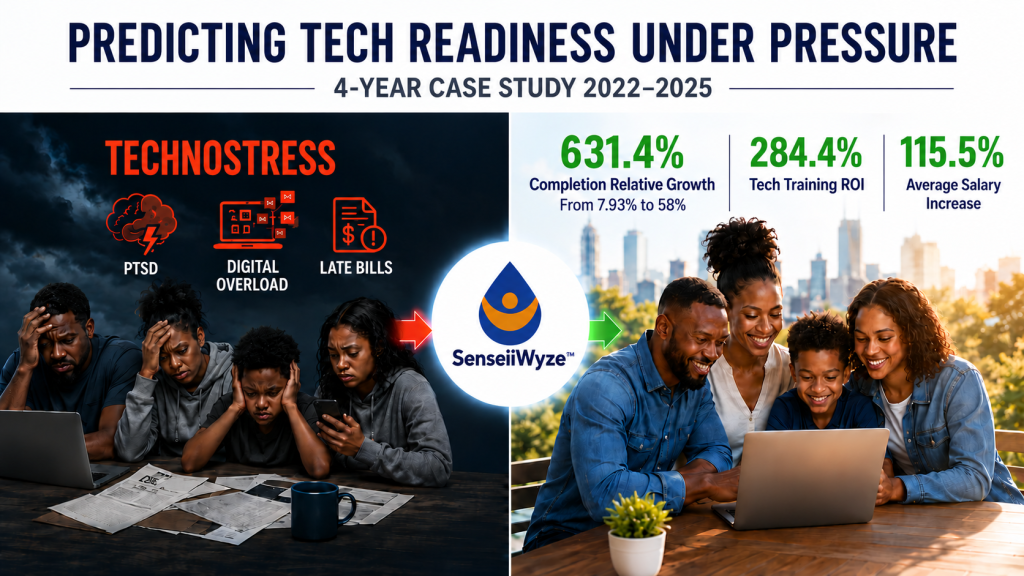
Automation Workz used SenseiiWyze™ predictive behavioral analytics to inform learner selection, coaching, support, and career preparation during a four-year Detroit technology workforce study.
Before SenseiiWyze™, Automation Workz’s completion rate was 7.93% — consistent with national norms. Following full implementation, completion rates rose to 58% with the same population, in the same city, pursuing the same certifications achieving a 631.4% growth of program completion.
The average graduating salary is $67,250 — a 115.5% increase over typical pre-program earnings of $31,200. Thirty percent of all graduates received and accepted salaries greater than $80,000. The top graduates landed at $166,000, $130,000,$120,000, $102,000 and $96,000.